Handball. Or handbol, as they call it in Europe. It is brutal, fast, and utterly exhausting to watch if you don’t know the rules. You step onto a smooth court, grab a ball with your hands, and try to throw it past a goalkeeper into a net. Simple, right? Wrong. It is a chaotic ballet of passes, dribbles, and physical contact that leaves fans breathless.
The clock ticks for 60 minutes. Two halves. Thirty minutes each. No time-outs to catch your breath. Just pure, unadulterated speed.
The Roster: Seven Players, One Goal
Each side fields seven players. That is it. No bench depth in the traditional sense you see in basketball. Every player matters. They have specific jobs, specific zones, and specific frustrations.
The Goalkeeper is the last line of defense. He is the only one allowed to use his legs inside the six-meter area. He cannot leave the crease. If he does, it is a free throw for the opposition. He sits in the shadows, waiting for a mistake.
The Center Back is the brain. He orchestrates the attack, passing the ball out to his teammates, looking for openings. He is the conductor.
Then you have the wings. Left and Right Wingers operate on the edges, closer to the goal. They are the snipers. When the play breaks down, they take the shot.
The Pivot operates in the center, right in the teeth of the defense. He is the brawler. He tries to score from close range, often using his body to block defenders.
And the Left and Right Backs? They are the heavy artillery. They come from deeper positions, throwing powerful shots from distance.
The Rules: Three Steps, Three Seconds
Here is where it gets tricky. You cannot hold the ball for more than three seconds. You cannot take more than three steps without dribbling. If you violate either, it is a turnover. The other team gets the ball.
This forces constant motion. Players are always running, always passing, always looking. There is no standing still.
The court is a rectangular surface, marked with lines that define zones and restrictions. The goal is 2 meters high and 3 meters wide. The goalkeeper must cover that entire area. It sounds impossible. It is.
Why Watch?
Because it is the only team sport where you can use your hands to throw a ball into a net while being tackled by three opponents. It is physical, it is tactical, and it is fast. If you think basketball is fast, try handball. The ball moves faster than the players. The transitions are sudden. One moment you are defending, the next you are sprinting down the court on a counter-attack.
There is a rhythm to the game. A pulse. It builds. You feel it in your chest.
The crowd roars. The players scream. The ball hits the back of the net.
That is handball.
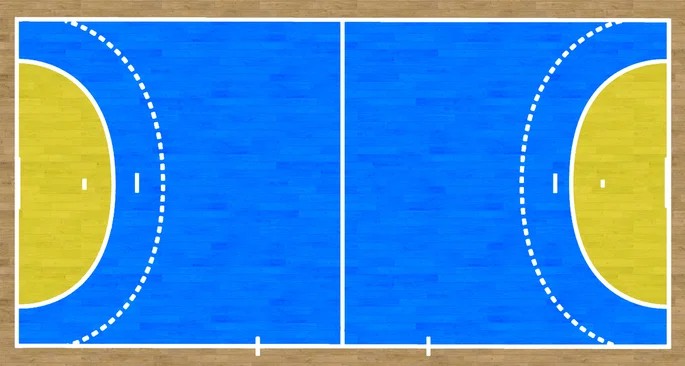
The court is a strict rectangle. 40 by 20 meters. Nothing more. Lines mark the boundaries, usually 5 cm wide, slicing the space into functional zones. The exception? The goal line. That one is thicker. 8 cm. You can see it. It matters.
The layout: Lines and boundaries
The long sides are touchlines. The short sides where the nets hang are goal lines. Flanking the goal line, just to the side, are the goal extension lines. Simple geometry.
The goals sit squarely on the goal line. They are two posts, 2 meters high, connected by a 3-meter crossbar. A net holds the ball once it crosses the threshold. And crossing that threshold is the only thing that counts. The entire ball must pass the line. If even a sliver of it is still touching the line? No goal. Precision matters.
The goal area: The keeper’s zone
This isn’t just an arbitrary box. It’s defined by a line drawn 6 meters out from the goal line, running parallel to it for 3 meters. From there, arcs with a 6-meter radius connect the ends of that line to the goal extension lines.
Inside this curved rectangle sits the goalkeeper’s restriction line. Only one player is allowed here. The keeper. Anyone else? Expulsion. This forces shooters to launch from the perimeter, creating distance and tension.
Secondary markings
You’ll spot other lines too:
– Center line : Splits the court in half.
– Free-throw line : A dashed line 3 meters from the goal area.
– 7-meter line : Exactly 7 meters from the goal, 1 meter long. This is where penalties happen.
– Substitution lines : Two segments near the center line for swaps.
See also: Difference between Handball and Soccer
Core rules: How the game actually works
Handball isn’t just running with a ball. It’s a constrained chaos. Players have far fewer freedoms than in soccer or basketball.
Try touching the ball with your feet or legs below the knee? You can’t. Unless you’re the keeper defending. And even then, only within the area.
Hold onto the ball for more than 3 seconds? Turn it over. Take more than 3 steps without dribbling? Turn it over. Play passively without attacking? Turn it over. You can’t even dribble backward toward your own goal. And don’t even think about stepping into the goal area. Only the keeper owns that space.
Team composition is flexible. 7 players on the court at once. Rosters can swell to 14 with subs. The keeper can swap into field play, but then they lose their special protections. Conversely, a field player can become the keeper, but then they must follow keeper restrictions. It’s a strategic shuffle.
Match duration is 60 minutes. Two halves of 30. A break of 10 to 15 minutes between. If it’s tied? You add two extra periods of 5 minutes each. Still tied? You go to 7-meter throws. A shootout. Other tie-breakers exist depending on the tournament, but this is the standard path.
Each team gets one timeout per half. The ball size varies by gender. Men’s balls have a circumference of 58–60 cm. Women’s are smaller at 54–56 cm.
Penalties are real. A yellow card might mean a 2-minute suspension. A red card? Permanent expulsion for violent or reckless acts. The stakes are physical.
Origins: Two paths, one sport
Handball didn’t emerge from nowhere. It split from two distinct lineages in the early 20th century. Both rooted in soccer, but developed in wildly different places.
1. El Balón (Uruguayan Ball)
Created in 1918 by Antonio Valeta in Uruguay. Valeta thought soccer was too violent. Too much kicking, too much collision. He wanted a “clean” sport. A game of respect.
His solution? Use hands instead of feet. Initially played with 11 players on a full soccer pitch. The theory was simple: if your hands are busy with the ball, you can’t tackle as hard. Less physical contact. More technical play.
2. Feldhandball
Born in 1919 in Germany. Karl Schelenz developed this version. It was a reaction to English soccer dominance. A need for a national sport that could compete.
Like El Balón, it used 11 players in soccer formations. But the field markings were different. The goal areas were flattened semicircles, closer to modern handball. The field was divided by three lines. It was structured, tactical, and distinctly German in its origins.
Both games shared soccer’s DNA. But they diverged. El Balón prioritized cleanliness. Feldhandball prioritized structure. Eventually, they merged into the handball we know today. The 7-a-side format won out. The 3-second rule stuck. The 7-meter throw became iconic. The sport evolved. The lines remain.