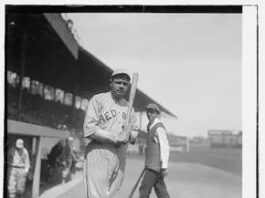
It started with a legal document. In 1902, George Ruth Sr., his mother, and a Justice of the Peace filed papers labeling seven-year-old George Ruth Jr. as “incorrigible and vicious.” The verdict was simple. The boy was beyond their control.
So, on Friday, June 13, his father took his tearful son by the hand. They walked him to the gates of St. Mary’s Industrial School for Boys. George begged. He promised to change. His tears did nothing. Rowdiness and truancy had cost him his freedom. He was now a ward of the Xaverian Brothers.
He would spend most of the next 12 years inside those walls. He didn’t leave until he signed a professional baseball contract.
St. Mary’s sat just outside downtown Baltimore. Six gray buildings. Several acres. Two ballfields named the Big Yard and the Little Yard. A wooden fence surrounded it. The boys called themselves inmates. It wasn’t a prison, at least not yet. It didn’t become a true reformatory until the 1930s.
The population was over 800 boys. Some were there for minor offenses. Some were orphans. Some were boarders whose parents paid for their stay. The “Orphaned Ruth” myth likely came from seeing orphans mixed in with the general population.
The Brothers didn’t care where the money came from. To them, all boys were fatherless. All needed discipline. Activity. Education. Training.
They were strict. But fair. Corporal punishment was rare. If you misbehaved, they took away privileges. And for a kid who loved baseball, being banned from the games was a death sentence. Desertion was rare. Boys stayed until they turned 21.
The mission was simple. Idleness breeds trouble. The schedule was rigid. Wake up at six. Wash. Dress for Mass and breakfast. Classes ran until ten. Recess. School or work until eleven-thirty. Dinner. Free time. More school until three-fifteen. Catholic doctrine classes for Catholics. Play in the Big Yard for the older boys. Supper at six. Reading in bed until lights out.
“It was at St. Mary’s that I met and learned to love the greatest man I’ve ever known. His name was Brother Matthias. He was the father I needed.”
The Giant Who Changed Everything
Brother Matthias loomed over everyone. Literally. He was six-foot-six. Two hundred and fifty pounds of quiet, pear-shaped power. He was the prefect of discipline and assistant to Brother Herman, who ran athletics.
Matthias didn’t need to shout. His presence quelled mutinies. He became teacher. Mentor. Coach. Friend.
George Ruth kept that bond for his entire life. Decades later, in his 1947 autobiography, he called Matthias the greatest man he ever knew. The father he needed. The man who taught him to read. To write. To know right from wrong.
George was sent back to St. Mary’s multiple times after early releases. Truant officers kept dragging him back. Regular school wasn’t working. For ten years, he could only visit family during holidays. Weekends were for his mother and sister Mamie.
Then came 1910. His mother died.
From that day until he left for baseball, no one visited. He felt the silence. He told a friend, “I guess I’m too ugly.” It was uncharacteristic self-deprecation. A crack in the armor that would never fully heal.
Sewing and Sweetness
Each boy chose a trade. Printer. Shoemaker. Electrician. Carpenter. Florist. Launderer.
George chose to sew shirts.
He made shirts for the school. Some were sold to outside vendors. He got paid a small amount for each shirt. He spent every cent at the candy store. Then he split his earnings among the younger kids.
It wasn’t charity. It was instinct. On cold days, he blew on the hands of shivering boys to warm them. He cared. He always had.
Babe Ruth never really outgrew being a kid.
From Shirtmaker to Slugger: The Early Days of George Ruth
The kid had hands that moved faster than his brain could track. Hand-eye coordination wasn’t just a trait; it was a superpower wrapped in rough hands. So naturally, his first real job was stitching shirts. Not because he loved thread and needle, but because he could do it faster than anyone else in the room.
Smelser, who dug into those early years, wrote that young George claimed he could whip up a shirt in under fifteen minutes. That’s not a mistake. That’s efficiency. The biographer figured if George had stuck to the trade, he’d be pulling in $20 a week. A solid wage back then. Respectable.
Fast forward. That same twenty-dollar bill would later become a trivial tip for breakfast at a fancy hotel. The scale of his earning power wasn’t just bigger; it was from a different galaxy.
But sewing was just a stopgap. A warm-up act. The real game was calling.
George Ruth Jr. wasn’t just good with a needle. He was waiting for a ball. As soon as he got near a diamond, the shirtmaker vanished. In came the batter.
To understand how he got there, you have to look at the minor leagues. The grind. The dust. The raw talent screaming to be let out. Baseball wasn’t just a hobby. It was an obsession masked as play.
For anyone tracking the evolution of the game, the transition from minor league prospect to major league icon is where the story truly clicks. The Hall of Fame isn’t just a building. It’s a museum of these exact moments. The shift from small-town shops to stadium lights.
Where did he start? The minors. How did he get noticed? By hitting balls that wouldn’t stay on the ground. Why does it matter? Because it set the template for the modern power hitter.
The rest is history. And the history is loud.