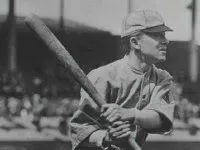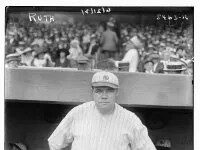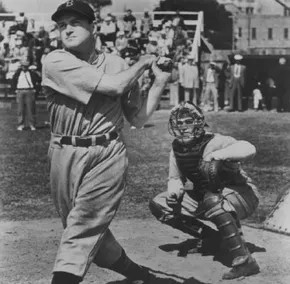
It was a scene that defied every logical expectation. At Chicago’s Comiskey Park, 49,200 fans watched as Babe Ruth, the aging legend, delivered yet another moment of pure magic during the first-ever All-Star Game. The American League led 1-0 when Ruth stepped to the plate in the third inning with Charley Gehringer on base. He didn’t just hit; he stroked a two-run homer off Bill Hallahan. It was the first home run in All-Star history.
Ruth wasn’t done dominating the day. Later in the game, he singled. When Cincinnati’s Chick Hafey hit a liner to right in the eighth, Babe made a spectacular running catch to end the National League’s final rally. The AL won 4-2, and Ruth’s hit was the game-winner. The old man was not finished.
How Ruth’s 1933 Season Started Strong But Faded
The first half of 1933 was a mix of personal brilliance and team-level disappointment. Ruth hit eight home runs in July alone, including three in a doubleheader against Detroit. But the team around him was slumping. The Washington Senators took the lead on June 24 and never let go. New York’s pitching staff was thin, and the pinstripers lost their imposing edge.
Ruth himself faded in the summer heat, managing only three homers in August. A turning point came on August 3, when Boston’s Lefty Grove shut the Yankees out. It marked the first time in 309 games that New York failed to score a run.
The Yankees finished second with a 91-59 record, seven games behind the Senators and 16 games off their previous season’s total.
The final game against Boston was a strange, poignant farewell. General Manager Ed Barrow staged Ruth’s first pitching appearance since 1930 as a climax to his 20th season. Facing the team for whom he had once starred as a pitcher, Ruth started with a 6-0 lead through five innings, helped by his own fourth-inning home run.
Boston fought back hard, reaching him for five singles and four runs in the sixth. Ruth, gulping water for strength between innings, held on for a 6-5 complete-game win. He allowed 12 hits, left the mound with a stiff arm he couldn’t lift for a week, and walked off to polite applause. He would never pitch in the majors again.
Why Lou Gehrig Took Over From Babe Ruth
While Ruth was fading, Lou Gehrig was peaking. In August, Gehrig broke Everett Scott’s major league record by playing in his 1,308th consecutive game. By season’s end, that streak stood at 1,350 games.
Gehrig’s 1933 numbers were historic:
– .352 batting average
– 41 doubles
– 32 home runs
– 139 RBIs
– 138 runs scored (led the league)
For the first time in his career, Gehrig outslugged Ruth (.605 vs. .582). The dynamic had shifted. Gehrig and Jimmie Foxx were the elite power hitters. Foxx captured the AL batting, homer, and RBI titles, achieving the Triple Crown, a feat that had always eluded Ruth.
Ruth finished with 34 homers, two more than his teammate but his lowest total since the “bellyache” season of 1925. His .301 average, 103 RBIs, and 97 runs were respectable for most players, but next to the Babe’s name, they felt wrong.
Which Player Won the 1933 AL MVP Award?
The Baseball Writers’ Association of America named the Most Valuable Player after the season. Jimmie Foxx won the honor for the second consecutive year. Lou Gehrig finished fourth. Babe Ruth did not receive a single vote.
The defensive side of Ruth’s game had declined sharply. He was slow and lumbering in the outfield. Only three of 24 regular AL outfielders made fewer putouts than him, and only eight made fewer errors. He was no longer the best slugger in baseball, nor even on his own team. That distinction belonged to Gehrig.
Was Babe Ruth Ready to Retire After 1933?
On paper, it looked like the right time to walk away. Ruth had played 20 years. He had appeared in 10 World Series. He had nearly 400 more home runs than anyone else in history. His skills were reduced, but still decent. New York had slipped, and further changes would be needed before another pennant. He could leave with his head held high.
But Ruth still had two specific goals that kept him in the game:
1. Hit his 700th home run (he was 14 away).
2. Become the manager of the Yankees.
The home runs seemed likely if he played another year. The manager job was a different story entirely. The quest for that job was about to begin.
Why Babe Ruth Was Never Considered for the Yankees Manager Job
Ed Barrow didn’t think Babe Ruth was the right person. That was the reality. Even though stars like Ty Cobb, Tris Speaker, and Joe Cronin had managed while still playing, and five out of sixteen big league clubs employed player-managers in 1933, the Yankee bosses stayed firm. Barrow felt no loyalty when it came time to reward the man who made the organization wealthy.
“At no time during the years he was with the club, from 1920 to 1934, was Ruth ever considered a candidate for manager of the Yankees,” Barrow wrote in his autobiography.
On paper, the argument for Ruth was strong. Two decades of playing. Pitching and hitting greatness. He had seen every situation a manager would face. His off-field behavior had cooled under his second wife, Claire. He wasn’t making base-running errors or throwing to the wrong man. Even if the claim that he never made a mistake was an exaggeration, his game knowledge was undeniable. He was slipping because of age, not the accumulated poundage. Yet for Barrow, the heartaches and salary squabbles of the past outweighed the baseball logic.
Ruth, trusting and naive, kept believing his chance was coming. When Miller Huggins died, Ruth imagined the job was his. It went to Bob Shawkey, Barrow’s fourth choice, who got fired after one season. Then, when the Cubs released Joe McCarthy, the Yankees snatched him up. McCarthy signed a three-year deal in 1933. Rumors swirled that Babe would get the post when it expired. Ruth stayed put, determined to be an active Yankee player until he got his due. He didn’t know he had no shot.
Missed Opportunities with the Red Sox and Tigers
Wanting to stay in the Bronx actually hurt Babe. He turned down real managerial openings because he was too busy waiting for New York.
The Red Sox were floundering in the second division. Five managers in six years. Attendance was dismal. Bringing back the most popular player in their history would have guaranteed a crowd surge. In 1932, Boston supposedly offered Ruth the job. He refused. He was on the way to a pennant with the Yankees and had high standing there. A year later, 33-year-old millionaire Tom Yawkey bought the Sox. He wanted Ruth too. But general manager Eddie Collins, like Barrow, had reservations. Collins talked Yawkey out of the offer. The Sox went with Bucky Harris.
Then came Detroit. Frank Navin, owner of the Tigers, discussed a deal with Barrow during the 1933 World Series. Barrow was anxious to shed the aging slugger and urged Ruth to meet Navin immediately. Ruth was about to leave his family for Hawaii, where he was booked for exhibition games. The ship and game reservations were set. He was confident. He told Navin he would meet him after he returned. It was five months until spring training. Plenty of time.
Barrow warned him he was making a mistake. Ruth didn’t listen. He left for the islands, ready for fun. Navin didn’t like the delay. He saw it as a snub. When Connie Mack began breaking up his great Athletics team, Navin moved fast. He grabbed Mickey Cochrane, a Hall of Fame catcher, to be his player-manager.
Ruth got back from Hawaii. He called Navin. The position was filled.
Detroit won the pennant the next two seasons under Cochrane. They topped it off with a world championship in 1935.
“I pulled one of the great boners of my career,” Babe admitted. “I don’t know if I could have done as well as Mickey, but I would have had pretty much the same material… I can’t help but wonder whether those pennants would have gone to me instead of Mickey if I had run out on the first part of my Hawaiian contract.”
The Newark Offer and Ruth’s Final Refusal
After the Detroit bad news, Barrow had one more play. He offered Ruth the manager job for the top Yankees farm club in Newark, New Jersey. The logic was simple. Get the experience needed to handle a big league post. Barrow figured it was a stepping stone to the job he never intended to give. He even threw in an incentive. A driver would pick Babe up daily from his Riverside Drive apartment and take him to work.
Ruth rejected it.
He didn’t want the farm job. He didn’t want the driver. He wanted the big chair in the Bronx. And because Barrow wasn’t going to hand it over, and Ruth wasn’t going to take a back seat to build his resume, the door stayed shut. The player-manager trend continued elsewhere, but not for the Babe. He remained a player, aging, wealthy, and just one step removed from the management position that had slipped through his fingers multiple times.
Ruth’s 1934 Contract: Salary Cuts and the Managerial Debate
The salary negotiations for the 1934 season were a strange dance. Barrow sent Ruth a $25,000 contract, less than half of what he had made the previous year. To make things worse, Barrow leaked those figures to the press before Ruth even saw the paper. When the two finally met at the brewery for the signing, there was no standoff. Just a handshake.
Colonel Ruppert stepped to the microphones and claimed he was “accommodating” Babe’s request for $35,000. The Yankees probably had that amount ready all along, but the framing mattered. It made Ruppert look generous. It made Ruth look reasonable.
“The management of the Yankees was not discussed,” Ruppert told reporters. “McCarthy is still our manager and will remain so for the next two seasons. I have no plans beyond that.”
Ruth had argued for a managerial role, comparing his experience to Joe Cronin, who was running the Senators at age 26. But the columnists who suggested a job for Babe in Cincinnati, under Larry MacPhail, were wrong. Nothing came of it. Ruth stayed in New York.
His pay had dropped $45,000 over three years, yet he was still the richest player in baseball. Mickey Cochrane was making $30,000 in Detroit. Chuck Klein of the Phillies was the only other player crossing that threshold. Lou Gehrig, the guy who was arguably playing better baseball, made just $23,000. Ruppert didn’t even give Lou a raise for his outstanding season. Gehrig was making half of Ruth’s money but twice the ballplayer.
Why Babe Ruth Faded in 1934: The End of an Era
The 1934 season wasn’t just a bad year. It was a reckoning.
Lou Gehrig had the finest year of his career. He won the Triple Crown with a .363 average, 49 home runs, and 165 RBIs. He stretched his playing streak to 1,504 games. Lefty Gomez threw a league-best 26 wins with a 2.33 ERA. Yet the Yankees finished second, seven games behind Cochrane’s Tigers.
The reason was obvious. You only had to look at the man batting behind Gehrig.
Ruth’s average was .288, fourth best on the team. He hit 22 home runs. Only two other players in the majors had fewer than that while playing 100 games. He had 84 RBIs. That was only the second time in his career he had failed to cross the 100-RBI mark in a full season.
The power era he had started was in full swing, but he was no longer part of it. He missed 29 games due to a bad back. He rarely finished games. His legs were gone. He was sluggish on the bases and useless in the field.
The Associated Press All-Star team? Zero votes for Ruth. The MVP ballot? Another shutout. Fans at Yankee Stadium started booing him before the season was over. One reporter wrote, “Tear down Faneuil Hall. Rip up the Constitution. They hooted Babe Ruth yesterday.”
The Symbolic Fall: Hubbell’s Strikeouts and the Shin Injury
The decline became tangible on July 10 at the All-Star Game in the Polo Grounds. Carl Hubbell, the Giants’ screwballer, struck out Ruth. Ruth was the first of five consecutive batters Hubbell fanned.
For Al Simmons, Jimmie Foxx, Joe Cronin, and Gehrig, that was a blip. For Babe, it was a symbol.
A few years earlier, Ruth would have taken two strikes on purpose, counted them on his fingers, and then launched a ball into the upper deck. In 1934, he just stood there.
He grew discouraged. The dugout held the daily reminder that Joe McCarthy held the job Ruth believed should be his. Ten days after the All-Star Game, Gehrig hit a ground ball that clipped Ruth on the right shin. Babe fell, waited for an ambulance in the clubhouse, and complained about not taking the day off.
He would cross the 700 home run mark before the season ended. But the man who broke that record was not the man who started it.