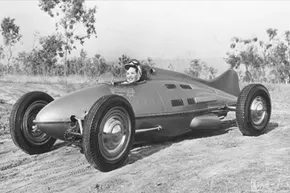
Picture this. You are strapped into a rusted, cast-off gas tank from a World War II fighter plane. The engine is screaming. You are hitting the salt flats at nearly 200 miles per hour. 322 kilometers per hour. It sounds like a death wish. It sounds insane. But for a specific breed of gearhead, it is the ultimate weekend.
This is belly tank racing. It did not start as a stunt for a marketing executive or a gimmick for the X Games. It evolved organically in the 1940s and 1950s. Mechanics and designers took surplus plane parts left over from the war. They welded them together. They sought speed. They sought records.
These racers became the platform for a generation. They set land speed records. They sparked the imagination of today’s hot rod culture. You might think your grandpa invented it, and in a way, he did. The activity is old. Very old.
The classic racers from that era are now historical artifacts. Too valuable to race. Too fragile to endure the g-force. But the descendants of those original hot rodders still race today. They still hit the lake beds. They still chase speed records. They still fight for bragging rights.
Today’s lakester race cars are different. They are more technically advanced. They are safer. They are faster. But they lack one thing the originals had. The appeal of being made from surplus military steel. There is a romance to the junk that modern engineering cannot replicate.
Take some discarded gas tanks. Add big engines. Add plenty of spare time. Find a dry lake bed. That is the recipe. It is the perfect mix for weekend wrench warriors setting speed records.
Want to know how fearless drivers squeezed themselves into metal tubes and raced into history? Want to see how $35 worth of military steel became legendary? Keep reading. Strap in. Squeeze your lucky rabbit’s foot. We are going belly tank racing.
The Origins of Belly Tank Racers
Why Aerodynamics Matter on Dry Lake Beds
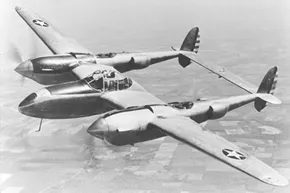
The logic was brutal and simple. A fighter plane needed range. It couldn’t carry enough internal fuel for long-haul missions over contested territory. The solution was a drop tank. Strap it to the belly. Carry the extra gas. Drop it when empty.
But there was a catch. Drag kills range. If the tank was too bulky, the plane burned more fuel fighting the air than the tank could possibly save. So engineers shaped them like giant bullets. Smooth. Sleek. Minimized turbulence.
Fast forward to the post-war surplus yards. Those aerodynamic shells sat rotting in the dirt. Hot rodders saw something else. They didn’t see fuel storage. They saw a body.
From Bomber Skins to Lakester Bodies
Land speed racing on dry lake beds—like Bonneville or Black Rock—requires one thing: straight-line stability at terrifying speeds. You need a vehicle that slices through the air rather than pushing it out of the way. Belly tanks offered that shape off the shelf.
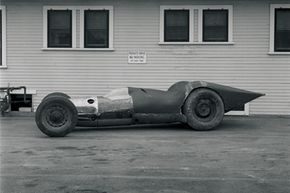
But the engineering convenience went deeper. Look at the rear of a typical WWII belly tank. It’s flat. Wide. Perfectly sized to mount a V8 engine and a rear axle assembly. You don’t need to fabricate a chassis frame from scratch. You bolt the drivetrain into the back of the tank and let the fuselage do the heavy lifting.
It was a marriage of military surplus and American ingenuity. A tank could be bought for roughly $35. That’s it. The shell, the aerodynamics, and the mounting points for pennies compared to building a custom fiberglass body.
The Rise of the Lakester
These vehicles earned a specific nickname: lakesters. They became the dominant force in the land speed record scene not by accident, but because they solved the fundamental physics problem of high-speed straight-line racing.
| Feature | Traditional Hot Rod | Belly Tank Racer |
|---|---|---|
| Body Shape | Custom steel/fiberglass | Original WWII aerodynamic shell |
| Drag Coefficient | Variable, often high | Extremely low (bullet-like) |
| Engine Mount | Custom frame fabrication | Direct rear-mount to tank opening |
| Cost (1950s) | High (materials + labor) | Low ($35 for the shell) |
The appeal wasn’t just aesthetic. It was functional. A traditional hot rod might look fast. A belly tank racer was fast because the air moved around it efficiently.
“The shape was already optimized for minimal drag. Why fight physics when you can buy the solution for $35?”
Builders didn’t just slap an engine in and pray. They reinforced the thin aluminum skin with internal bracing. They calculated weight distribution carefully. But the core advantage remained: the aerodynamic profile was a freebie from the aerospace industry.
This wasn’t about nostalgia. It was about efficiency. If you want to break a land speed record, every ounce of drag is a penalty. Every pound of weight is a hindrance. The belly tank offered a lightweight, aerodynamically superior enclosure that required minimal modification.
The result? A breed of racer that looked like a missile and performed like one too. They dominated
The Raw, Exposed Cockpit Experience
You aren’t signing up for luxury when you strap into a belly tank racer. There are no plush seats. No climate control. Just a cramped metal box that feels more like a punishment device than a vehicle. The driver sits roughly in the middle of the fuselage, staring down the barrel of a runway.
Some designs cut small holes in the tank so you can poke your head out for a better view. Others slap on a bubble canopy or a wire cage. Most don’t bother with any windshield at all. That means when you’re hitting 200 mph across the dry lake beds, you’re eating wind, grit, and whatever sand the ground has decided to launch into the air. Bring goggles. You will get sand in your teeth. It’s part of the charm, if you can call it that.
Engine Placement: The Shift to Rear-Midship
Early belly tank racers, often called lakesters, played it safe. They mounted the engine in front of the driver. Why? Because the first racers were built from 165-gallon (625-liter) tanks salvaged from P-51 Mustangs. Those tanks were too short to fit a driver and an engine behind them. The engine went up front, pushing the car.
Things changed when builders started scavenging larger 315-gallon (1,192-liter) tanks from P-38 Lightning fighters. Suddenly, there was room. They could slide the driver forward and tuck the engine behind them. This rear-engine, mid-mounted layout became the standard for most belly tankers and lakesters. It offered better weight distribution for the chaos they were about to invite.
The engines themselves varied wildly, but the rule was simple: bigger was better. Classic racers relied on American V-8s because hot rodders had easy access to them. Ford, Mercury, and Chrysler blocks set records. If you wanted speed, you bolted on whatever big-block American muscle you could find.
Wheels on the Sides, Not Below
Look closely at a belly tank racer and you’ll notice the wheels aren’t under the body. They stick out to the sides, forward and aft. It looks weird. It looks unstable. It’s actually the opposite.
Because the tank is so narrow, putting wheels underneath would make the car a teeter-totter waiting to flip. Mounting them on the sides widens the stance. It adds stability. And stability is everything here.
Unlike modern race cars, these tanks don’t have spoilers. Spoilers—those wings on the back of a car—use aerodynamics to push the vehicle down at high speeds, keeping the tires planted. Without downforce, a light car gets light. Belly tank racers are light. A bad bump in the desert floor or a sudden crosswind can lift them right off the ground. They fly if you let them.
The Legacy of the Dry Lake
“Belly tank racers don’t have spoilers, and because of the speed at which they travel, plus their light weight, a bad bump or cross breeze could send them airborne.”
Modern lakesters have big shoes to fill. They’ve inherited the spirit of raw, unfiltered speed built from war surplus. They don’t promise comfort. They don’t guarantee safety. They promise adrenaline, wrapped in a fuselage that used to fly over Europe and the Pacific.
If you have a spare tank and a death wish, the next step is building one. But first, you need to understand what happens when physics stops caring about your suspension.

Forget the engine for a moment. You need space. Vast, flat, and hard-packed space. That is the other half of the land speed record equation.
Across California, Nevada, and Utah, the dried beds of prehistoric lakes offer exactly that. These salty expanses are smooth. They are wide open. Hot rodders have known this since the 1930s. Today, the Bonneville Salt Flats in Utah are synonymous with speed. Cars have topped 600 miles per hour there. That is 966 kilometers per hour.
Official records require precision. During Speed Week at Bonneville, a car gets two runs. The average speed of those two passes determines the final result. One bad run can ruin the average.
The So-Cal Speed Shop Legacy
Alex Xydias and his So-Cal Speed Shop are central to this history. They built a racer from the belly tank of a P-38 Lightning fighter plane. It was a military surplus shell with a 156-cubic inch V-8 engine. In 1951, they hit 145 miles per hour at Bonneville.
It was fast for the time. But they didn’t stop.
They swapped the engine for a bigger unit. The average speed jumped to 181 miles per hour. They swapped it again. If one engine works, why not try another? The third iteration averaged 195 miles per hour.
Other Classic Rivals
The So-Cal machine wasn’t the only one chasing numbers. Mal Hoopster built a Chrysler-powered belly tank racer. It broke the So-Cal record by averaging 197 miles per hour.
Bill Burke also mattered here. He worked at So-Cal Speed Shop. He is widely credited with first noticing that belly tanks made great race cars. He built one that reached 131 miles per hour. It was slower than Hoopster or Xydias, but it proved the concept.
Valuing History
Those 1940s and 50s classics are expensive now. You won’t see them at your local track. The So-Cal racer that hit 195 miles per hour is worth nearly $200,000 today. That is a lot of cash for a metal shell.
But you don’t need to buy history to see it. Go to Speed Week at Bonneville in August. Watch the heirs of the belly tank racer’s legacy go head-to-head. They hit speeds the original builders could only dream of.
The salt is still there. The flat is still smooth. The records keep moving.