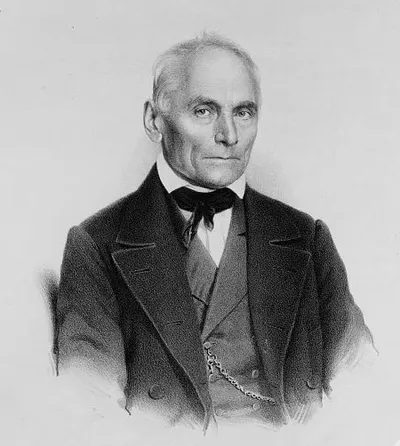
Jan Evangelista Purkinje was born in Libochovice, Bohemia, on December 17, 1787. He died in Prague on July 28, 1869. This Czech pioneer did not just study life. He helped build the modern understanding of it. His work in histology, embryology, and pharmacology changed how we see the eye, the brain, the heart, and even the cell itself.
He earned his medical degree from the University of Prague in 1819. Later, he served as a professor of physiology there from 1850 until his death. But his fame began earlier. He discovered a visual quirk now known as the Purkinje effect.
The Purkinje effect describes how, as light intensity decreases, red objects appear to fade faster than blue objects of the same brightness.
This study of human vision caught the eye of J.W. von Goethe. The German poet befriended Purkinje, who was then a student in Bohemia. Goethe likely helped secure Purkinje a chair in physiology and pathology at the University of Breslau, Prussia, from 1823 to 1850.
Building the First Physiology Lab
Breslau became a hub for scientific rigor. Purkinje created the world’s first independent department of physiology in 1839. He followed that with the first official physiological laboratory, the Physiological Institute, in 1842. He was a founder of laboratory training tied to university teaching in Germany.
His discoveries were precise and lasting. In 1837, he identified large nerve cells with branching extensions in the cerebellum. Scientists still call them Purkinje cells. Two years later, he found the fibrous tissue that carries the pacemaker stimulus through the heart’s ventricles. These are Purkinje fibres.
He also introduced the term protoplasm to describe the substance of young animal embryos. It stuck.
Innovations in Microscopy and Toxicology
Purkinje was a toolmaker as much as a thinker. He was the first to use the microtome for slicing thin tissue sections. He also pioneered the use of glacial acetic acid, potassium bichromate, and Canada balsam in tissue preparation. These methods allowed for clearer microscopic examination.
His work in toxicology was equally ahead of its time. In 1829, he documented the experimental effects of camphor, opium, belladonna, and turpentine on humans. He recorded the visual distortions caused by poisoning with digitalis and belladonna.
Everyday Discoveries
Many of Purkinje’s findings are so common we forget they were once unknown.
- In 1833, he discovered the sweat glands of the skin.
- In 1836, he noted the protein-digesting power of pancreatic extracts.
- In 1825, he described the germinal vesicle, or nucleus of the unripe ovum. This structure now bears his name.
Perhaps most intriguingly, Purkinje recognized fingerprints as a means of identification in 1823. This was decades before forensic science made them a standard tool.
Why His Work Matters Today
We rely on his basic observations daily. When you see a blue sign fade before a red one at dusk, you are experiencing his discovery. When doctors examine heart rhythms, they trace the path of the fibres he mapped. The very cells that process sensory input in your cerebellum carry his name.
Purkinje did not just observe. He built the infrastructure for observation. The lab he created became a model. The