


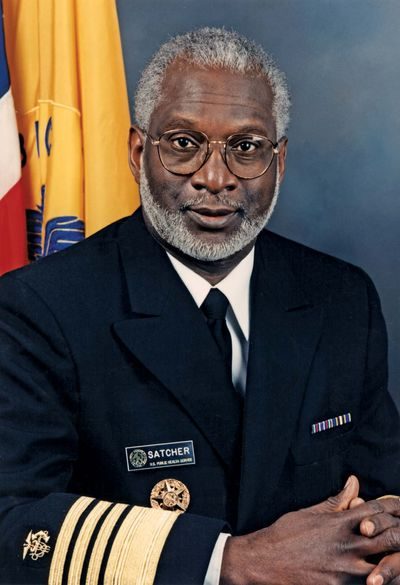
David Satcher wasn’t born with a silver spoon. He was born near Anniston, Alabama, in 1941 to a small farmer. His family was poor. They had almost no access to health care. When he was two years old, he nearly died from whooping cough. The only black physician in the area treated him. That moment stuck. He decided then and there that he would become a doctor.
His path wasn’t easy. He attended a racially segregated high school. He was valedictorian. Only three students from his class went to college. He earned a B.S. from Morehouse College in Atlanta in 1963. This was a historically black institution. It mattered. It shaped his perspective on medicine.
By 1970, he had achieved something historic. He became the first African American to earn both an M.D. and a Ph.D. in cytogenetics. He did this at Case Western Reserve University in Cleveland, Ohio.
Breaking Barriers in Medical Education
Satcher didn’t stop at degrees. He moved into administration and teaching in Los Angeles during the 1970s. He worked at the Charles R. Drew Postgraduate Medical School. He also worked at the King-Drew Sickle Cell Center, which was affiliated with the school. He taught at UCLA’s School of Public Health too.
In 1979, he returned to Morehouse. He chaired the department of community medicine and family practice. Then, in 1982, he became president of Meharry Medical College in Nashville, Tennessee.
Meharry was in trouble. The school had been dedicated to training African American doctors for 100 years. But it was on the verge of losing its accreditation. Financial security was shaky. Faculty were scarce.
Satcher fixed it. He recruited new faculty. He strengthened the academic standing. He secured the financial future of the school and its teaching hospital. He saved Meharry.
Leading the CDC and CDC Health Initiatives
In 1993, President Bill Clinton appointed Satcher as the director of the Centers for Disease Control and Prevention (CDC). This was a major shift. He focused heavily on disease prevention.
He pushed for initiatives to raise childhood immunization rates. He addressed emerging infectious diseases. He worked to prevent food-borne illnesses. These were practical, hands-on public health measures.
His success at the CDC led to his next role. He was appointed surgeon general. He assumed these duties in February 1998. He served until January 2001. During this time, he also served as assistant secretary of health in the Department of Health and Human Services.
These two positions gave him a powerful platform. He could shape biomedical research policy. He could emphasize public health issues on a national scale.
Addressing Health Disparities and Tobacco Use
As the nation’s chief doctor, Satcher tackled tough topics. He presented a report to the president on tobacco use. The focus was on health risks for minorities and minority teenagers. Smoking affected these communities disproportionately.
He commissioned a report on suicide prevention. Mental health was often ignored. He urged the nation to have an “honest debate” about it. You don’t talk about suicide in the 90s without facing resistance. He pushed anyway.
He sought to eliminate race-based health care disparities. This was a core theme of his career. He believed that health outcomes shouldn’t depend on your skin color.
The Controversy of Sexual Health and Later Leadership
In 2001, Satcher released a report that made waves. It was called The Call to Action to Promote Sexual Health and Responsible Sexual Behavior. It was groundbreaking. It was also controversial.
The report emphasized research-based strategies. It addressed issues related to sexual health directly. Some people didn’t like it. Satcher didn’t care. He believed in the science.
After his term as surgeon general ended in February 2002, he didn’t rest. He became director of the National Center for Primary Care at the Morehouse School of Medicine. He served as president of the medical school from 2004 to 2006.
His interest in improving public health policy remained strong. So did his drive to cultivate leadership and diversity in the sector. In 2006, he developed the Satcher Health Leadership Institute at Morehouse School of Medicine.
He received many awards throughout his career. The New York Academy of Medicine gave him a Lifetime Achievement Award in 1997. The Jimmy and Rosalynn Carter Foundation gave him their Award for Humanitarian Contributions to the Health of Humankind in 1999.
Satcher’s story isn’t just about titles. It’s about a boy from Alabama who almost died. It’s about a man who fixed a dying medical school. It’s about a leader who forced the nation to talk about things it didn’t want to discuss.
Tobacco. Suicide. Sexual health. Race.
He didn’t shy away. He kept working. The Satcher Health Leadership Institute is still there. The issues he raised are still with us.
How much of his work do we still ignore?