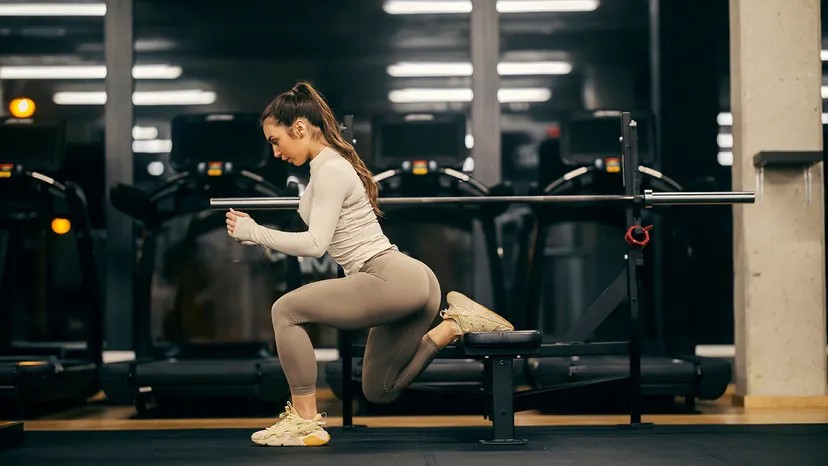
Split squats look deceptively simple. One foot forward. One foot back. Just up and down. But that plain setup masks a powerhouse lower body exercise. It forces one leg to handle the heavy lifting while the rest of your body scrambles to stay upright.
Think of it as a squat with a balance challenge baked in. Instead of splitting the weight evenly between your feet, this move leans into one side. That bias helps you spot strength gaps between your left and right legs. It also builds the quads, glutes, hamstrings, and calves with precision.
How Split Squats Work
A split squat is a unilateral movement. This means it trains one side of the body at a time. You start by placing your front foot flat on the floor. Step your back leg behind you. Keep your torso tall, as if a string is gently pulling your chest upward.
Bend both knees. Lower your body toward the ground. Your front knee tracks over your front foot. Your back knee drops toward the floor. Hips move through a controlled range of motion. Then, press through the heel of the front leg to return to standing.
The front leg usually takes most of the load. The rear leg assists with balance. It should not steal the show. This is why split squats are such effective single-leg training tools. They force the working leg, hip, and knee joint to solve the stability problem. The stronger side cannot take over.
For a basic bodyweight version, keep your shoulders stacked over your hips. Brace your core. Point your toes straight ahead. Leaning forward slightly cues the quads to work harder. Sinking straight down shifts the focus to the glutes.
If you feel wobbly, do not panic. That is not a flaw. Your muscles, joints, and nervous system are learning to coordinate stability in real time. It is like a camera tripod adjusting to uneven ground.
Split Squat vs. Bulgarian Split Squat
The Bulgarian split squat is a variation that places the rear foot on an elevated surface. Usually, this is a bench. That small change makes the movement feel much bigger. The back leg has less contact with the ground. The front leg has to do more pushing.
Set up by placing the top of your back foot on the bench behind you. The bench should be around knee height for most people. Comfort matters more than copying a perfect measurement. Keep one foot forward far enough that your front knee can bend without your heel popping off the floor.
The Bulgarian split squat often feels more demanding than the regular version. It increases the balance challenge. It allows for a deeper bend.
Research comparing the Bulgarian split squat with the back squat found that the Bulgarian version still loads the hip and knee heavily. It changes how the ankle, knee, and hip share the work (International Journal of Exercise Science).
Regular split squats are usually the better starting point. This is especially true if you are new to lower body training. You need to learn how your front knee should track first. Add the elevated surface only when your position feels steady. Make sure your knees move smoothly. Control the bottom of the motion without bouncing.
Muscles, Balance, and Lower Body Strength
Split squats train several muscles at once. The quads straighten the knee. The glutes help drive hip extension as you stand. The hamstrings and calves assist with control. The hips, core, and smaller stabilizing muscles keep the body from tipping to one side.
This makes the exercise more than just a leg burner. It can improve balance. Each rep asks your foot, ankle, knee, and hip to work as a coordinated stack.
Your core strength matters too. If your torso folds forward or your shoulders twist, the movement becomes less efficient.
Unilateral vs. Bilateral Movement
Unilateral work also has a practical sports performance angle. Many athletic actions happen on one leg or one side at a time. This includes cutting, landing, accelerating, and changing direction speed.
A systematic review and meta-analysis on unilateral and bilateral resistance training interventions found that unilateral training may better support unilateral jumping. Bilateral movements may have an edge for bilateral strength (Biology of Sport).
That does not mean one style wins forever. Bilateral movements like a traditional squat let you train both legs together. You can often use more total weight. Split squats let you train one side with precision. A smart exercise routine can include both.
Strength work should balance opposing muscle groups, such as quads and hamstrings. Do not hammer one area only. Since muscles and tendons create movement by pulling on bones across joints, understanding how muscles work makes the split squat feel less like choreography. It feels more like physics you can feel.
“Split squats let you train one side with precision, whereas bilateral movements let you train both legs together and often use more total weight.”
Why does your back knee drop so low in the regular version but barely touch the air in the Bulgarian? Because the bench changes the leverage. You have to push harder to get up. Is it worth the extra difficulty? Only if you can control the descent. Bouncing at the bottom defeats the purpose. It turns a stability exercise into a momentum game. And momentum rarely fixes strength imbalances.
The split squat is not just about leg size. It is about connection. When your front foot is planted and your back foot is floating or elevated, your body has to find its center. You are not just moving weight. You are teaching your nervous system how to stabilize.
Most people skip unilateral work because it feels awkward. Or they avoid it because they are tired. But if you want strong, balanced legs, you cannot ignore the side that feels weaker. The split squat forces the issue. It does not let you hide behind your dominant leg.
There is no perfect setup. No single angle fits every body. Find the foot placement that lets your knee track over your toes. Find the height that allows full range of motion without pain. Then repeat. The balance will come. The strength will follow.
Start with your left foot forward and right foot back. Lower slowly until your back knee approaches the floor, then push through the front foot to stand. After your reps, rest and switch sides so the right foot is forward and the left becomes the back foot.
When it comes to the front foot, keep the heel down, spread the toes, and let the whole foot grip the ground. Your front knee should generally travel in the same direction as your toes rather than collapsing inward.
A little forward knee motion is not automatically bad. A biomechanics study on the split squat found that step length and front tibia angle can change joint angles and loading during the exercise (Journal of Strength and Conditioning Research).
In plain English, where you put your feet changes how the knee, hip and ankle feel the rep.
Try these form tips:
-
Keep your chest tall and your shoulders relaxed.
-
Brace your core before each bend.
-
Let both knees bend instead of turning the move into a stiff-legged dip.
-
Keep the front foot planted from toes to heel.
-
Stop the set if sharp pain changes your motion.
Don’t Ignore Pain
Pain at the front knee can come from many causes, including training load, mobility, strength, previous injury or irritated tissue around the knee joint.
If you feel knee pain, reduce the range of motion, shorten or lengthen your stance slightly or return to a body weight version. Consult a clinician or qualified trainer if pain persists, especially after a knee injury.
Adding Weight to Your Workout Routine
Once body weight split squats feel controlled, you can make the exercise harder by holding dumbbells. Holding a dumbbell in each hand at your sides is the most straightforward setup.
You can also hold one dumbbell near the chest with the elbows tucked, which the American Council on Exercise uses in its Bulgarian split squat instructions (ACE Fitness). Other athletes may opt to for a racked position on their shoulders.
Weight changes the conversation. Your legs still do the main pushing, but your torso, shoulders, elbows and core have to keep the load from pulling you out of position. Start lighter than you think you need. The floor will quickly tell you whether your balance and stability are ready.
Split Squat Frequency
For a simple training plan, add split squats to lower body workouts one or two times per week. You can also use split squats as a bridge between basic exercise and harder athletic training.
A regular split squat teaches the position. A Bulgarian split squat adds the elevated surface. Holding dumbbells adds resistance. Each step should earn its place in your workout routine, not barge in before your body is ready.
The best version is the one you can repeat with control: front foot rooted, back knee tracking down, chest steady, hips moving cleanly and no sharp pain.
That is where lower body strength becomes useful outside the gym, whether you are climbing stairs, pushing off one leg, lifting from the floor or trying to improve balance during everyday motion.
We created this article in conjunction with AI technology, then made sure it was fact-checked and edited by a HowStuffWorks editor.