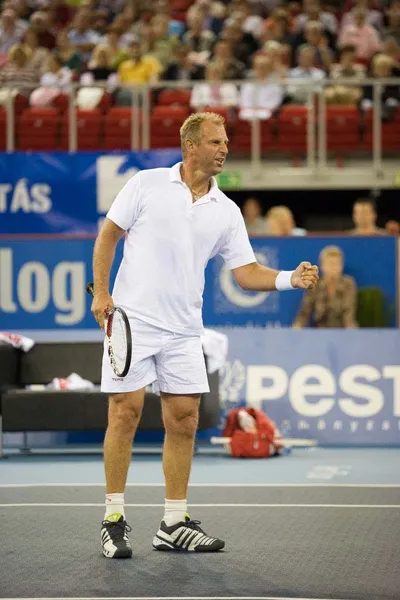
Thomas Muster didn’t just play tennis. He owned the dirt.
Born October 2, 1967, in Leibnitz, Austria, Muster became the first Austrian to lift a Grand Slam trophy. He did it at the 1995 French Open. His dominance on clay courts defined the 1990s. You couldn’t stop him when the ground was red.
His path to glory was almost cut short before it really began. Muster turned pro in 1985. He had finished 10th in junior world rankings the year prior. By 1988, four titles pushed his ATP ranking to 16th. He looked unstoppable.
Then came March 30, 1989.
He had just beaten Yannick Noah of France to reach the finals of the Lipton International in Key Biscayne, Florida. He was seconds from breaking into the top 10. Unloading gear from his car trunk, another vehicle smashed into him. The impact severed ligaments in his left knee.
Surgery fixed the leg. But would he ever walk comfortably? Could he even play again?
Determined to return, Muster worked with coach Ronald Leitgeb. They designed a special chair. He used it to hit balls while his leg healed. Six months later, he was back on the tour. He finished that year ranked 21st.
His career took a specific shape after that. Except for one title on hard courts at Adelaide, Australia, in 1990, every tournament he won was on clay. The slower pace of the surface masked the weakness in his knee. It turned a liability into a fortress.
He finished 1990 ranked seventh in the world. His mastery of clay was only beginning.
By 1995, his clay court winning streak hit 35 matches. He beat American Michael Chang in straight sets (7–5, 6–2, 6–4) to win Roland Garros. The streak grew to 40. At the time, it was the third longest in the Open era. Only Björn Borg (44) and Guillermo Vilas (53) had longer runs.
This victory propelled him to world number three. He finished the season ranked third, having won a record 12 ATP titles. The final one came at the Eurocard Open in Essen, Germany. It was his first indoor win.
Muster’s dominance didn’t fade in 1996. He held the world number one ranking for six weeks between February and April. A hip injury in October slowed him down. He still managed a top 10 finish in 1997.
He retired in 1999. He occasionally played on the seniors tour after that. In 2010, he briefly returned to the ATP Tour before retiring for good the following year.
But the legacy of the Austrian left-hander remains. He changed how players viewed the clay court. He made it a weapon.